

Standard drink vs actual alcohol amount
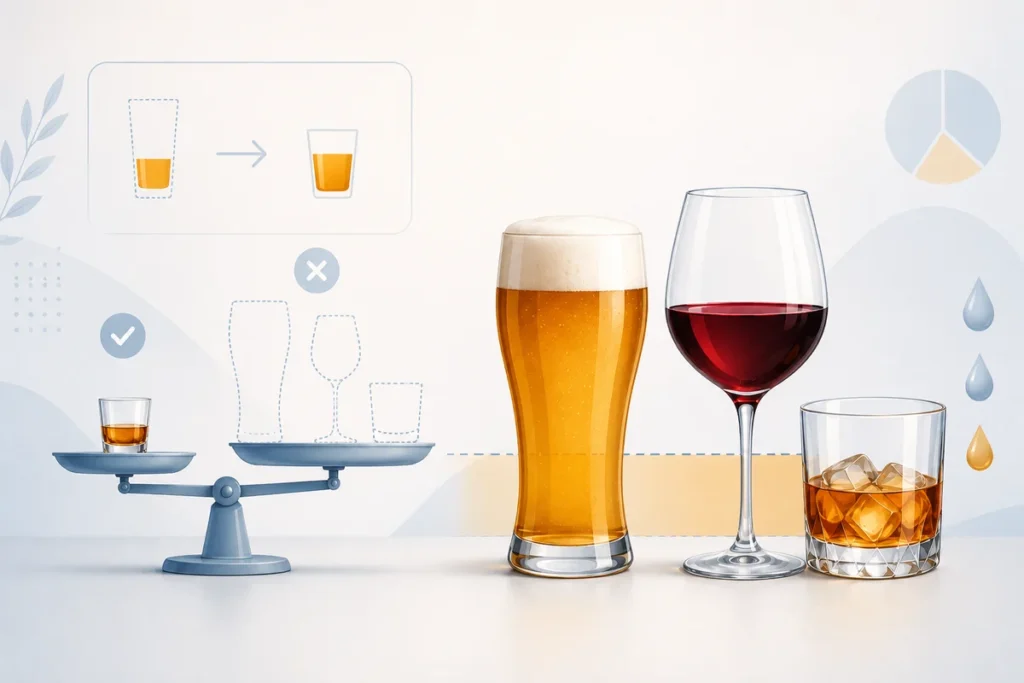
A “standard drink” can make alcohol easier to discuss, but it is not one shared measure worldwide. Its definition depends on the country and source. For a daily entry, what matters more is what was actually in your glass: the drink’s volume and its alcohol strength. ABV stands for Alcohol by Volume. In practice, it is the alcohol percentage shown on the label, such as 5% vol., 12% vol. or 40% vol.
Why a serving name can mislead
“One beer” might mean a small bottle, a large can, or a half-litre pour. A “glass of wine” can be different at home and in a restaurant. Even at the same volume, the alcohol amount changes with the % vol. on the label. A count of servings therefore does not always describe the actual alcohol amount as clearly as grams do.
A standard drink is also not health advice, a legal limit, or permission to drive. A source from another country may use a different definition, so a simple comparison of “how many drinks” is not always meaningful. If you drank, do not drive — regardless of serving counts or a BAC estimate.
Grams of pure alcohol are a neutral way to describe your own entries. They let you compare different drinks without assuming that every “beer” or “cocktail” means the same thing. They do not need to become a judgement of yourself; they are simply a shared unit for observation.
From the label to grams
The amount of alcohol follows from the drink’s volume and the alcohol strength (% vol.) on the label. The formula is:
ml × alcohol strength (% vol.) as a fraction × 0.789 = grams of alcohol
For example, a 500 ml beer at 5% vol. contains about 19.7 g of alcohol. You may still call it one beer, but that quantity may differ from a standard drink in a particular educational source. /en/how-to-calculate-grams-of-pure-alcohol/ explains the formula in detail.
You do not need to calculate this by hand in QS AlcoRhythm. The app converts an entry to grams automatically once you choose or enter the volume and the % vol. value from the label — you can also use a preset or quick entry. The formula is worth knowing simply to understand why a larger serving or a higher alcohol strength changes the result.
For cocktails, identify whether you know the alcoholic component’s volume and strength, or the final % vol. of the whole drink. Enter the ingredient’s values in the first case, or the full drink’s volume with its final strength in the second. Do not combine both methods. A mixer changes volume but does not contribute alcohol.
Keep entries simple
The simplest habit has three steps:
- Record what you drank, plus volume and alcohol strength from the label when known.
- Choose or enter the closest volume and % vol. — the app does the conversion to grams.
- Compare your entries with previous weeks, not with someone else’s drink definition.
You do not need perfect accuracy. When you do not know the glass size, note the best reasonable estimate. Consistency across similar situations matters more than one perfect number. That makes it easier to see a weekly rhythm, alcohol-free days, and occasional larger entries.
If you use servings as shorthand in conversation, keep them as a helpful label. For your own comparisons, rely on volume, alcohol strength (% vol.), and grams.
That also makes earlier entries easier to reread: concrete figures are clearer than guessing what “one drink” meant that week.
It reduces unnecessary ambiguity.
QS AlcoRhythm
/en/apps-en/qs-alcorhythm/ converts each entry to grams automatically from its volume and label alcohol strength, and shows entries in grams and standard drinks to support personal observation. It does not replace medical advice, and standard-drink definitions remain country- and source-dependent.
Observe your weekly rhythm with QS AlcoRhythm
QS AlcoRhythm helps you calmly track drinks, weekly limits and history — stored locally on your device, without an account.